


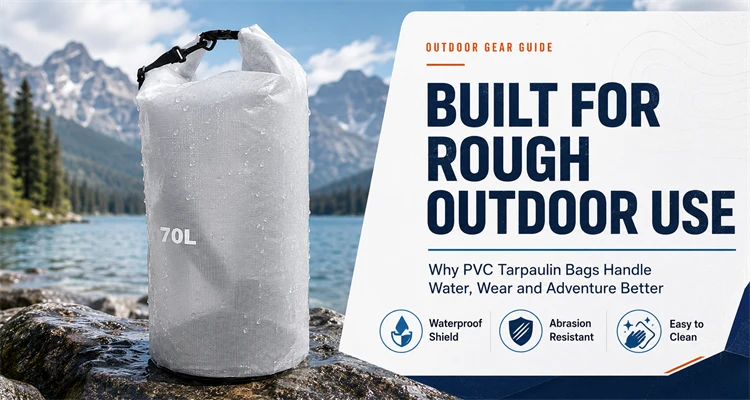
PVC tarpaulin is a great option for outdoor use due to its part woven fabric construction. The woven fabric’s primary role is to provide support while a PVC coating forms a water barrier and wipe clean surface that is capable of being joined by a welding process. However, the ability of the bag to maintain use and service is multifaceted. The strength of the base fabric, the weight of the coating, the overall stiffness of the seam, reinforcements, and the intended use of the bag all affect the performance of the bag.
PVC Tarpaulin Is a Layered Material System
PVC tarpaulin is more accurately described as a coated or laminated textile as opposed to a piece of plastic. Understanding these layers helps explain why this material is suitable for outdoor use and flexible enough for a bag.
The Woven Base Fabric Carries the Load
A woven polyester base, usually a grid pattern present in the material, gives the tarpaulin tensile and tear strength. When a bag is pulled, compressed, or otherwise stressed, the internal textile evenly disperses the stress on the panel as opposed to relying the coating to take the full force of the stress.
Yarn strength and weave density, as well as fabric structural design, influence how a bag handles stress at various points. A strong panel can still fail if concentrated loads are not adequately addressed, and therefore, reinforced.
The PVC Coating Creates the Protective Surface
The base fabric has PVC surrounding or covering it to form a protective surface. This surface allows the panel to repel water, wash dirt off the yarns, and have a wipeable surface, whereas untreated woven textiles do not have any of these surface properties. The surface of the tarpaulin resists scuffing during loading, transportation and contact with wet surfaces.
The coating’s thickness is important. Poor adhesion of the coating leads to separation of the coating, even if the base fabric is intact.
Surface Finish and Formulation Change the Result
PVC tarpaulins differ based on surface finish, color, plasticizer system, cold flex formulation, optional resistance treatments and many more factors. They affect the feel of the surface, the surface’s ability to clean, look and perform in different conditions such as hot, cold or sun exposure.
This means that two bags, both labeled as PVC tarpaulin, could feel and perform drastically different. When evaluating a product the construction of the finished good and the material specifications should be taken into consideration and not just the coating.
How the Material Handles Outdoor Wear
Abrasion Resistance for Repeated Handling
Outdoor bags are put through a lot. They are dragged across decks, placed on gravel and storage surfaces, and come into contact with a lot of other things. A PVC coated surface acts as a barrier of protection between the base fabric and these contact and wear surfaces. Because of this, work bags and bags meant to be in contact with water, such as fishing and rafting bags, are made with a heavier PVC construction.
Limits to abrasion resistance mean that sharp objects, like metal edges or hooks, can damage even heavy materials. Sharp edges are easier to deal with if you use a bag with rounded corners, protect corners, reinforce bases, and pack bags sensibly.
Water Blocking Through the Main Panels
Large PVC panels allow main panels to be used in the rain, as well as on muddy and wet decks. A woven fabric relies on a light layer of treatment for protection. A tarpaulin requires a much more heavy and continuous coating.
A waterproof panel may not make a finished product fully submersible. The quality of seals, roll tops, zippers, and fabric reinforcement are very important and should be considered.
Easy Cleaning After Mud, Salt, or Fish Handling
A smooth coated surface does not readily trap loose dirt in exposed yarns, so mud and splash residue can often be removed with water and a soft cloth according to the care instructions. This is especially useful for bags used around fish, bait, boats, campsites, or equipment that returns home wet.
Salt, sand, organic residue, and cleaning chemicals should not be left on the surface indefinitely. Rinsing, mild cleaning, full drying, and open storage help protect the coating, hardware, and seams. Harsh solvents or stiff brushes may damage the finish and should be avoided unless specifically approved.
Weather Performance Depends on the Formulation
UV exposure and extremes in temperature change some materials. Outdoor-grade formulations may offer options for improved UV resistance and color stability and low temperature flexibility, but those properties may vary. A general PVC label does not guarantee performance in a specific temperature range or resistance to weathering.
Products for use in persistent exposure to strong sun, cold weather, or even repeated transport in and out of marine environments, should be selected according to the material manufacturer’s data for the specific products used. Reduced aging occurs during storage and no unnecessary heating is needed. Sealing out light and sun during storage will slow the aging process of the material.
Why PVC Tarpaulin Works Well With Welded Seams
Welding Can Join Coated Panels Without Needle Holes
High frequency welding is one of the processes used to join PVC coated fabric, and hot air or hot wedge welding are suitable as well. High frequency welding and hot air welding both employ a controlled heat and pressure method for fusing overlapping coated surfaces. The result is a seam with no needle holes.
PVC tarpaulin’s high frequency welded seams and general compatibility with various welding processes provide a strong, repeatable seam and clean panel construction, and make this material ideal in tarpaulins and roll-top closure systems found on most dry bags.
Seam Design Still Determines Finished Strength
A welded seam is not automatically reliable simply because welding was used. Overlap width, electrode or tool design, temperature control, pressure, dwell time, panel alignment, and contamination all affect the joint. Handles and straps may need separate reinforcement because they introduce peeling and pulling forces that differ from pressure across a flat seam.
Finished products should be evaluated at transitions where several layers meet, including corners, roll-top ends, valve bases, strap patches, and shaped panels. These locations reveal whether material choice and construction have been designed as one system.
Closure Design Defines the Water-Protection Boundary
Roll-top closures are a simple design in comparison to a zippered closure. A roll-top closure requires both the top edges of the bag to align and a roll to be made and secured with a buckle. A draw back of the roll-top closure is that water penetration can still occur. A zipper closure can maintain water resistance, but can also be compromised based on the zipper and closure.
Neither closure should be described beyond its use. Rain and water splashes and accidental brief immersions can be distinguishable from prolonged submersion. The rating or test condition for the finished product can be more useful and informative than the material of a single panel.
Outdoor Products That Benefit From PVC Tarpaulin
Bolsas secas
The advantages of a roll-top dry bag include surfaces that can be easily cleaned and the use of either lightweight or heavier material to integrate welded panels. A lightweight bag might be adequate for general camping while a heavier bag is appropriate for continual use in rough wet conditions on a boat, raft, etc.
Fish Bags and Cooler-Style Storage
Finished products that interface with food and are in contact with salty wet despoiled organic material, abrasive, and heavy and frequently cleaned require design that incorporates insulation, PVC tarpaulin, zippers, handles, and internal reinforcing.
A fish bag must resist deformation when filled with ice and catch. Load paths surrounding handles and drainage fittings merit additional consideration since these areas accumulate force and break the main panel.
Mochilas impermeables
Waterproof backpacks use PVC tarpaulin when robust panels and welded construction are more important than ultralight pack weight. Roll-top models can reduce the number of openings, while zipper-access designs may favor convenience. Shoulder straps, back panels, and external attachment points normally require stitched or reinforced assemblies that must be integrated without creating weak water-entry paths.
When comparing PVC tarpaulin bags, match the finished product to its actual role: a simple dry bag, a fish-storage bag, and a wearable waterproof backpack place different forces on the same material. Product pages should make the bag structure, closure, carrying system, dimensions, and intended exposure clear rather than presenting PVC as the only durability feature.
Thickness and Weight Should Match the Product
Heavier Is Not Always Better
A heavier tarpaulin can improve body, abrasion tolerance, and resistance to rough handling, but it also increases packed weight and folding stiffness. A hiking-oriented gear bag may benefit from a lighter construction, while a boat or fish bag can justify more material weight. The best balance depends on panel size, load, climate, and carrying distance.
Thickness should therefore be evaluated alongside base-fabric strength and coating quality. Two materials with similar total weight can differ in yarn construction, coating distribution, flexibility, and weld response.
Reinforcement Should Follow the Load Path
Heavy materials placed everywhere on a gear bag are less useful than concentrated reinforcement in high contact and load areas on the gear bag. These areas typically include: the base, the lower corners, patches of handles, body panels where shoulder straps engage, connections of hardware, openings of hardware, drainage or valve openings.
Good reinforcement spreads force into the main panel without creating a hard edge that becomes a new fold or wear point. Hardware should also match the bag weight and intended environment; an excellent tarpaulin cannot compensate for a weak buckle, zipper, webbing, or connector.
Care Practices That Support Long Service
- Remove sand, salt, mud, fish residue, and trapped debris after use.
- Clean with methods approved for the specific coating and hardware.
- Dry the bag fully before closing it for storage.
- Avoid long-term folding along exactly the same sharp crease.
- Keep sharp tools and exposed metal from pressing against the panels.
- Inspect welded seams, corners, handles, straps, buckles, and zippers regularly.
- Store away from unnecessary heat and prolonged direct sunlight.
Minor surface marks do not always affect water protection, but deep cuts, coating separation, cracked folds, or lifting seams deserve attention. Use a repair method that is compatible with the exact material and the product’s intended exposure.
Preguntas frecuentes
Is PVC tarpaulin completely waterproof?
Although the coated sheets create a strong water barrier, the finished bag will not remain protected unless all seams and closures are sealed, and the workmanship is up to par. Assume that PVC bags are not submersible unless otherwise stated or tested on the product.
Are thicker PVC tarpaulin bags always more durable?
No. Thickness does improve abrasion resistance and strength, but base fabric, coating, weld, reinforcement, and design all play a part. Heavier thickness may not be needed for casual use or long distance carrying.
Why are welded seams useful in dry bags?
Welds seal together two coated fabrics without sewing a hole for a break in the barrier. High quality performance, however will still depend on proper thickness of overlap, machine settings, clean fabric, and reinforcement.
Can PVC tarpaulin bags be used in cold weather?
It depends on the material blend, but you should check the flexibility of the material at low temperatures to avoid breaking the bag. Don’t assume every PVC-coated fabric is the same.
Durability Comes From the Complete Bag Construction
PVC tarpaulin is a great choice for making outdoor bags because it provides textile reinforcement, waterproof and washable coating, abrasion resistance, and tolerance to welded seams. However, the material’s true durability is evident when the weight of the material, design of seams, closure, hardware, reinforcement, and regular care are considered in the context of the product. Analyzing this entire system allows us to understand why PVC can be used to manufacture dry bags, fish bags, and waterproof backpacks without considering each PVC construction as the same.
