


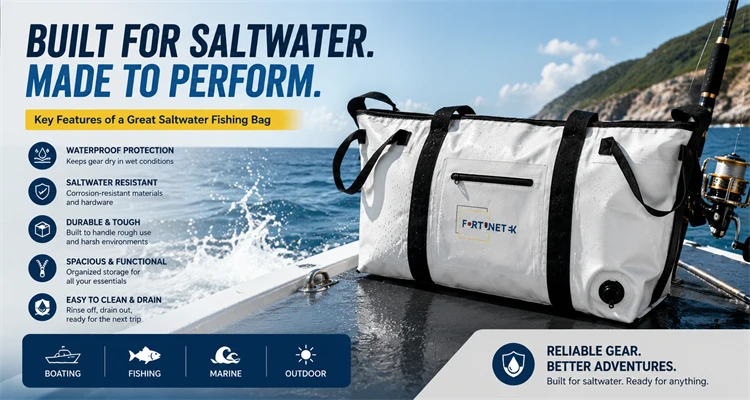
Fishing bags are designed to accommodate wet conditions. As fishing bags are placed on decks, exposed to splashes and salt, frozen, and rinsed after use, insulation and waterproofing are not the only measures that must be taken. Fishing bags must address the residues of fishing, malodor, and the weight of fish, as well as consider the nature of the outdoors.
The dimensions of fishing bags are determined by the waterproofing, ease of cleaning, drainage, retention of cold, strong straps, and the ability to withstand salt as well as fasten the separation of tools, bait, fish, and personal belongings.
Waterproof Materials for Wet Fishing Conditions
Fishing bags must accommodate exposure to waves, rain fishing sand and mud, and rough treatment. Because of its resistance to water and ease of cleaning, the most common outer material of fishing bags is PVC Tarpaulin. Welded construction is also facilitated by its durability. For a more premium feel, TPU laminated fabric is an option.
Fishing bags must be lightweight and easy to fold and carry in order to accommodate the weight of fish and ice. The outer material must also be easy to clean, and therefore smooth and a little bit textured.
| 素材 | Why It Works | Best Use |
|---|---|---|
| PVC tarpaulin | Durable, water-resistant, easy to clean, weldable | Fish bags, boat bags, bait bags, rugged fishing storage |
| TPU laminated fabric | Softer feel, flexible, premium appearance | Premium fishing bags and lightweight waterproof gear |
| Coated nylon or polyester | Lighter textile look, flexible styling | Small accessory pouches and light tackle bags |
| EVA or semi-rigid shell | Shape retention and impact protection | Bait cases, compact cooler sets, tackle organizers |
Easy-Clean Surfaces After Fish, Bait, and Saltwater
Fishing bags need to be cleaned often. Fish scales, bait residue, saltwater, sand, and melted ice can leave odor and stains if the surface traps dirt. A wipeable surface makes the bag more practical after real fishing use.
Smooth PVC or TPU surfaces can be rinsed and wiped faster than ordinary woven fabric. Interior corners, seams, drain areas, and pockets should also be designed to avoid residue traps. A bag that looks rugged but is difficult to clean will feel less useful after a few trips.
Drainage Valves for Melted Ice and Rinse Water
A drainage valve is a feature that is found in most large fishing bags and coolers that is quite practical. It allows for the water that has melted ice or water that has been used to rinse the bag to drain without having to tip the bag over, which is very helpful if the bag is to be used in a boat, dock, or while transporting seafood.
Drainage valves should be placed in areas that make draining the bag efficient. The valves should also be well sealed to keep them from leaking and should be easy to open with hands that are wet. During transport, the cap and gasket should remain in place. If the valve is difficult to clean, the drainage area will be a place that fish residue will collect.
Cold Retention and Insulation Layers
If the fish have to be kept in a bag to keep the fish in good condition for a later time during the fishing trip, then the fish will need to be kept in a bag that has retention of cold to ensure that the fish will be in a good condition. A fish cooler bag is a bag that usually consists of an outer waterproof fabric, a layer of insulation foam, and a waterproof lining. The insulation helps to slow the transfer of heat to the outside and the lining helps to keep the contents of the bag from leaking to the outside.
Cold retention depends on insulation thickness, foam type, lid structure, zipper quality, seam construction, and how often the bag is opened. Thick insulation can help, but it also adds bulk. A well-designed fish cooler bags product balances cold performance with carrying comfort and storage size.
| Feature | Effect on Cold Retention | Practical Note |
|---|---|---|
| Insulation foam | Slows heat transfer | Thickness should match bag size and trip length |
| Waterproof lining | Helps hold ice and melted water | Smooth surfaces are easier to clean |
| Lid or zipper design | Reduces warm air entering the bag | Wide openings need reliable closure quality |
| Seam construction | Affects leakage and heat gain | Welded or well-sealed seams are useful |
| Drainage valve | Removes melted ice water when needed | Must seal securely after draining |
Shoulder Straps and Handles for Heavy Loads
Fishing bags can easily become heavy with ice, water, fish, bait and tackle. Straps and handles need to support that weight while still being comfortable. Handles and straps that are designed to make bags easier to transport include padded handles, adjustable straps, along with reinforced stitching and welded attachment points.
For heavy bags, side handles can help two people lift the bag onto the boat. A shoulder strap will be more useful for lifting bags in and out while shore and pier fishing. Compact handles and tie down points will be more useful for kayak fishing than having large padded straps.
Saltwater Tolerance and Hardware Choices
Compared to freshwater, saltwater is more damaging to materials. It can cause rough zippers, leave residue, and affect metal hardware. Bags that are designed for fishing in saltwater need to have hardware and closures that are salt resistant and that can be rinsed after use to remain in good condition.
To improve saltwater corrosion resistance, use plastic hardware, zip pulls, and coated and unstruthing attachment points. The bag should be rinsed with freshwater and dried before storage, after saltwater trips.
Storage for Fish, Bait, and Tackle
A good fishing bag will have storage for clean and unclean, wet and dry items that can be easily separated. Fishing should not be storing ice and fish alongside snacks, drinks, and dry clothing. Bait should be stored in a clean transportable zone. Fishing tackle should be easily accessible and storage should be puncture free.
Incorporating interior dividers, removable liners, mesh pockets, tool loops, exterior pockets, and small waterproof pouches will improve the functionality of the bag. The design should accommodate the specific style of fishing whether it is boat, surf, kayak, pier, or seafood transport.

Feature Priorities by Fishing Scenario
| Fishing Scenario | Most Important Features | Helpful Add-Ons |
|---|---|---|
| Boat fishing | Drainage valve, reinforced handles, saltwater-tolerant hardware | Bright color, non-slip bottom, wide opening |
| Kayak fishing | Compact size, splash protection, tie-down points | Small pouches, shoulder strap, light insulation |
| Shore or pier fishing | Shoulder comfort, easy cleaning, bait separation | Tool pockets, removable liner, waterproof phone pouch |
| Seafood transport | Cold retention, leak control, large capacity | Thicker insulation, drain valve, side handles |
| Bait storage | Small size, wipeable lining, odor control | Clear label area, simple zipper, compact handle |
Zippers, Openings, and Access
Wide openings simplify packing. Fish, ice, bait trays, and gear all load easier through a large opening. However, all large openings need a closure. Zippers should function even after exposed to moisture and salt. Splash and cover flaps should be used to keep the top cleaner.
Fish cooler bags should have closures designed for both accessibility and the ability to retain cold. The balance between a large opening and a closure that minimizes warm air infiltration is important. A closure should also minimize leakage during transport.
Visibility, Color, and On-Deck Use
A bright fishing bag is easier to see from a dispersed or crowded boat, dock, beach, or kayak. Darker bags will conceal stains better but bright bags will be fast to locate.
A good fishing bag requires a stable base. A bag bottom that has a reinforced base is beneficial to its use. A bright bag with a top panel that is visible, and a lower panel that is a dark bottom is a good design.
Care Tips for Longer Service Life
- Rinse saltwater, bait residue, and fish scales after each trip.
- Open the bag fully and let it dry before storage.
- Drain melted ice water through the valve instead of leaving it inside.
- Clean around zippers, seams, and drain caps where residue may collect.
- Avoid storing sharp tackle loose against the lining.
- Do not overload straps beyond the intended carrying weight.
Common Feature Mistakes
- Choosing a fishing bag that is water-resistant outside but hard to clean inside.
- Using a large cooler bag without a drainage valve.
- Ignoring saltwater effects on zippers and hardware.
- Putting fish, bait, tools, and personal items into one undivided space.
- Choosing thin straps for a bag that will carry ice and fish.
- Focusing only on insulation while ignoring cleaning and drainage.
FAQ About Waterproof Fishing Bags
What material is best for waterproof fishing bags?
PVC tarpaulin is widely used because it is durable, water-resistant, easy to clean, and suitable for welded construction. TPU laminated fabric is often used for softer premium designs.
Do fishing bags need a drainage valve?
A drainage valve is very useful for larger fish bags and cooler bags because it helps remove melted ice water and rinse water without tipping the bag.
How do fish cooler bags keep fish cold?
They use insulation foam, waterproof lining, closure design, and ice packing to slow heat transfer. Cold retention also depends on how often the bag is opened.
Are waterproof fishing bags suitable for saltwater?
Many fishing bags can be used around saltwater if the material, zipper, hardware, and seams are designed for wet conditions and the bag is rinsed after use.
How should bait and fish be stored in the same bag system?
Fish, bait, tackle, and personal items should be separated with liners, pouches, dividers, or separate bags so residue, odor, and moisture do not spread everywhere.
結論
Waterproof fishing bags work best when every feature supports real wet use. Durable waterproof material, wipeable surfaces, drainage, insulation, strong straps, saltwater-tolerant hardware, and organized storage all matter on the water.
For fishing gear, the most useful bag is not only the one that keeps water out. It is the one that handles fish, bait, ice, saltwater, cleaning, carrying, and repeated trips without making the process harder.