


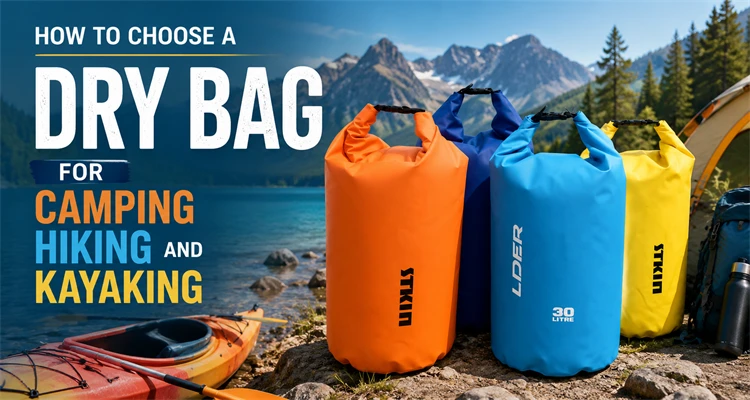
The right dry bag depends on factors such as where it will be used, how much gear it needs to hold, and if it will be carried in a packed bag or used as a main bag. There are also the factors of organized capacity, weight, carrying comfort, and even splash exposure. Kayaking can also affect what closure and attachment points you will need. The type of activity you plan on participating in can help dictate the capacity and the type of material. It can also help you decide what types of straps you need prior to purchasing a dry bag.
Match the Dry Bag to the Activity
A single dry bag can be used for multiple activities, but the balance of factors such as protection versus weight, access, and carrying comfort will be unique for every activity. Use the selector to see what dominant factor is for the activity you are planning on doing the most to help you with your dry bag selection.
| Деятельность | Typical packing pattern | Main exposure | Design priorities |
|---|---|---|---|
| Кемпинг | Clothing, sleeping items, food, and camp electronics | Rain, wet ground, condensation, and mixed storage | Several capacities, broad opening, durable base, easy identification |
| Пешие прогулки | Layers, food, maps, electronics, and emergency items inside a backpack | Rain, sweat, stream crossings, and repeated packing | Low weight, flexible fabric, efficient shape, minimal hardware |
| Каякинг | Clothing, phone, camera, food, and safety items stored on or in the boat | Spray, paddle drips, wet decks, and possible short immersion | Secure roll-top, strong seams, attachment points, abrasion resistance |
Dry Bag for Camping
When you go camping, you often carry more gear. However, you also get to take a break from having to carry lots of things at once. A camping dry bag can help you carry and store your clothes, spare layers, sleeping bag, and other things you may need at camp. It can also help you keep your clothes and bag gear separate from gear that gets wet from cooking. One oversized bag may seem practical, but a few small, color-coded bags make finding small things in the tent and gear so much easier.
When deciding on a bag, pay attention to the fabric on the bottom. You want a bag that is made of tougher fabric, since it will probably encounter wet soil, gravel and rough surfaces. Although it makes packing easier to have a wide opening, you have to consider how much is actually left to roll the bag.
Dry Bag for Hiking
A dry bag for hiking is usually carried inside a backpack, so low weight and shape efficiency matter. Lightweight coated nylon or polyester can protect clothing, maps, food, and electronics from rain or moisture inside the pack without adding the bulk of a heavy external dry bag. Softer fabric also conforms more easily around other equipment.
Do not choose a bag so large that every item must be opened at the same time. A small valuables bag, a separate clothing bag, and a compact emergency-item bag can improve access while keeping the main backpack balanced. If the dry bag will be carried outside the backpack, confirm that the straps and attachment points are designed for that load rather than improvising with the roll-top buckle.
Dry Bag for Kayaking
Closures, seams, and attachment systems take a beating in kayaking. Wet decks and spray from paddling are a constant threat. Hidden hatches or a capsize mean equipment is fully exposed to water. Evaluate the actual water exposure threat, and read the manufacturers info on water resistance/ingress ratings to determine how water resistant a bag is.
A smaller bag is easier to fit inside the kayak hatch. However, a bag fills to a diameter greater than the opening, so bags as a whole need to be small. Deck bags should attach securely away from paddling obstructions and exits. Inner pouches are a good idea to protect more sensitive gear like phones from a main dry bag where the environment is not totally dry.
Build a Capacity System Instead of Choosing by Liters Alone
Use Capacity as a Starting Range
Labels with capacity describe the bag’s internal volume, and don’t always account for what will actually fit with the top rolled. The amount of space that can be utilized also depends on the bag’s shape and how much closure material there is. With that in mind, small bags are good for holding small, individual items like keys; larger bags are good for personal items, a small amount of clothing, and food for a day trip; even larger bags can hold more bulky items, like camping gear or a group supply; larger bags can hold the most, but can be used for more bulky items.
These examples are not meant to be strict guidelines. A winter jacket, for example, will take up more space than a sweatshirt, and a camera in a stiff case will occupy space differently than clothing. Close the bag with the correct amount of closure, and then test to see if that bag will fit in the space you want to transport it to, like a hatch on the roof of a car, a backpack, or a boat.
Decide Between One Large Bag and Several Small Bags
One large dry bag requires less closure to secure the bag, but they can be more cumbersome and difficult to search through because they can hold one large item.
The downside of many bags is that they require more closure, bags for wet items have to remain separate and organized, and they can be more cumbersome and difficult to pack in a narrow hiking or kayaking pack.
A good system of organization separates items based on how often they are accessed and how important the item is. Place frequently used items in a bag with a system. Organize sensitive electronics in a different bag and your extra clothing and sleeping items in a separate bag that remains closed until you reach your campsite. Stuffing bags to max capacity isn’t a good idea because a fully packed top bag leads to an inconsistent roll.
Compare Material and Waterproof Construction
Lightweight Coated Fabrics
Coated nylon and polyester are great choices when pack weight and flexibility are priorities. They can work well as backpack liners and internal organizers on hiking and travel packs. Fabric denier, coating type, seam method, and base reinforcement all affect the fabric’s overall strength, so the performance of the fabric can’t be simply understood by the material name.
Lightweight fabric constructions become more fragile and require more care around sharp objects, gravel, and rough surfaces. If the fabric does not include some sort of repair system, consider placing hard and sharp objects away from the fabric.
PVC and TPU-Coated Materials
PVC tarpaulin and TPU-coated fabrics are used where abrasion resistance, easy cleaning, and welded seams are of importance. Heavier coated materials are normally used in boating, fishing, rafting, and rugged camp use. A TPU construction may be used to achieve a more flexible and lightweight construction, and PVC is used to construct lower-cost and more durable products.
The complete laminate has to be considered when making material decisions. Base fabric, thickness of the coating, manufacturer’s flexibility in cold temperature tests, surface texture, weld quality, and total bag weight should be considered as a whole. Just because a material is heavy, doesn’t mean it is more waterproof; if the seams or closure are poorly done, then it will still get wet.
Seams and Published Protection Levels
Welded seams, which eliminate the need to puncture the material to sew, are used in the construction of outdoor waterproof bags. Sewn seams can be taped or sealed and provide decent protection in lightweight jackets, but the overall design and construction will determine the level of protection.
Waterproof, water resistant, and submersible do not mean the same thing. A typical dry bag with a roll-top closure, for example, is designed to protect contents from spray and exposure to the elements, but is not designed to be used in sustained submersions. You should examine the published methods and limits for the test performed on the bag and the rated ingress.
Evaluate the Closure and Carrying Design
A Roll-Top Needs Enough Material to Seal
A roll top closure is constructed by bringing the two inflexible edges together and rolling the top a specific number of times, determined by the manufacturer, and securing the closure with a buckle. In many instances, multiple tight rolls will provide a better seal than a single loose roll, but the length of the contacted sealed edge may still be important.
Overpacking can also cause buckle and seam stress issues. Evenly space your roll to prevent fabric from getting trapped and webbing from twisting and to stop objects from pressing up against the closure and impeding it from sealing. The roll actually closes with the buckle; do not think of it as the one and only way to lift the bag unless the bag was designed for it.
Straps Should Match the Carrying Distance
A simple handle variation or a removable shoulder strap may work for moving camping bags to and from the car and the campsite. When carrying the bag over greater distances, an improvement in spreading the load requires wider straps and separation attachment points. Backpack-style dry bags should fit the bag wearer and remain stable instead of pulling from a single narrow connection.
For hiking, a dry bag typically does not need its own shoulder strap since extra hardware will unnecessarily add weight to the bag and will possibly get caught on other pieces of equipment. The attachment loops for bags on a kayak should be strong enough with quick access for removing the bag and should be placed so the bag does not restrict movement of the paddle.
Weight Matters Differently in Each Setting
Hikers will notice the burden of extra weight most, so in this case, the lightest construction to provide safety should be chosen. Campers can afford more weight in fabric since greater abrasion resistance and easy cleaning are important benefits. Kayakers should consider the balance between ruggedness and the size of the hatch and the overall stability of the boat and weight for removing it on shore.
Compare total packed weight, not fabric weight alone. Straps, buckles, reinforcement panels, valves, windows, and extra pockets can all add weight. Features are useful only when they support the actual trip.

Pack and Test the Bag Before the Trip
A short home check can reveal most fit and handling problems. Pack the real equipment, leave enough room for the closure, remove excess air without forcing it, and fasten the roll-top according to the instructions. Then place the bag in the backpack or kayak hatch and confirm that it can be removed without scraping or pulling on the buckle.
- Separate sharp or rigid objects from the coated fabric.
- Keep frequently used gear in a smaller, accessible bag.
- Check seams, buckle engagement, strap stitching, and attachment loops.
- Confirm the loaded bag fits through the intended hatch or compartment.
- Use an additional inner pouch for highly water-sensitive valuables when conditions justify it.
- Dry and clean the bag before long-term storage.
When reviewing waterproof dry bags, compare complete constructions that match the activity rather than choosing from capacity labels alone. A suitable product page should make material, seam method, closure style, strap configuration, dimensions, and intended water exposure clear enough to support a realistic packing decision.
Avoid Common Dry Bag Selection Mistakes
- Choosing the largest size without checking the filled diameter or hatch opening.
- Assuming every product labeled waterproof is designed for prolonged submersion.
- Packing above the closure line and leaving too little material for the roll-top.
- Using an ultralight bag directly on rough ground without considering abrasion.
- Adding heavy straps and hardware to a bag that will only be used inside a backpack.
- Attaching a kayak bag where it obstructs movement, exits, or safety equipment.
Часто задаваемые вопросы
What size dry bag is best for camping?
There is no best size for camp dry bags. Small bags let you separate your gear, medium sized bags let you bring clothes or food, and big bags let you carry big camping equipment. Always bring space in your bag to close the bag with a roll.
Is a dry bag for hiking different from one for kayaking?
For backpacks, hiking dry bags need to be lightweight, strong, and flexible, while kayaking dry bags need to be sealed and have abrasion resistance. The same dry bags can be used for hiking and kayaking as long as it is designed to protect the contents and carry the load under the conditions.
How many times should a roll-top dry bag be rolled?
Follow the manufacturer’s instructions because closure designs vary. The rolls should be tight, even, and free from trapped objects or twisted fabric. If the bag is too full to complete the specified closure, reduce the load.
Will a dry bag keep a phone or camera safe underwater?
Only use a bag for immersion when the manufacturer specifically states that capability and provides an appropriate test or ingress rating. For sensitive electronics, a second protective pouch adds useful redundancy in wet environments.
Choose for the Trip You Will Actually Take
Not all bags are created equally. The right dry bag meets the activity, the load, and deliberates for the water exposure. Sizing matters, and so does the durability. Most campsites don’t offer dry bags, so its packaging might be the difference between staying dry and going home early. Low weight and efficient packing dry bags are the best for hiking. Since there’s a higher chance of your kayak getting some spray, or that your ship gets submerged, you’ll want the dry bag to have good closure, seam and attachment choices. The final decision you should make is determining the simplest design that will provide you the necessary protection and usability for your route. Take a final walk with your loaded bag for the journey in the position you will be transporting it, to ensure that it will serve its function to your ability.